What happened
Anthropic launched Claude Fable 5 as a generally available model this week. The headline case study: Stripe reported compressing a two-month, fifty-million-line Ruby migration into one day using the model's sustained autonomous capability.
The pricing landed at ten dollars per million input tokens and fifty per million output tokens. Fable 5 is included on standard subscription plans through June 22.
Why the sustained-focus capability matters more than the benchmarks
Anthropic reports state-of-the-art results on nearly all tested benchmarks. That matters to researchers and developers evaluating models. For a commercial team, the meaningful shift is different.
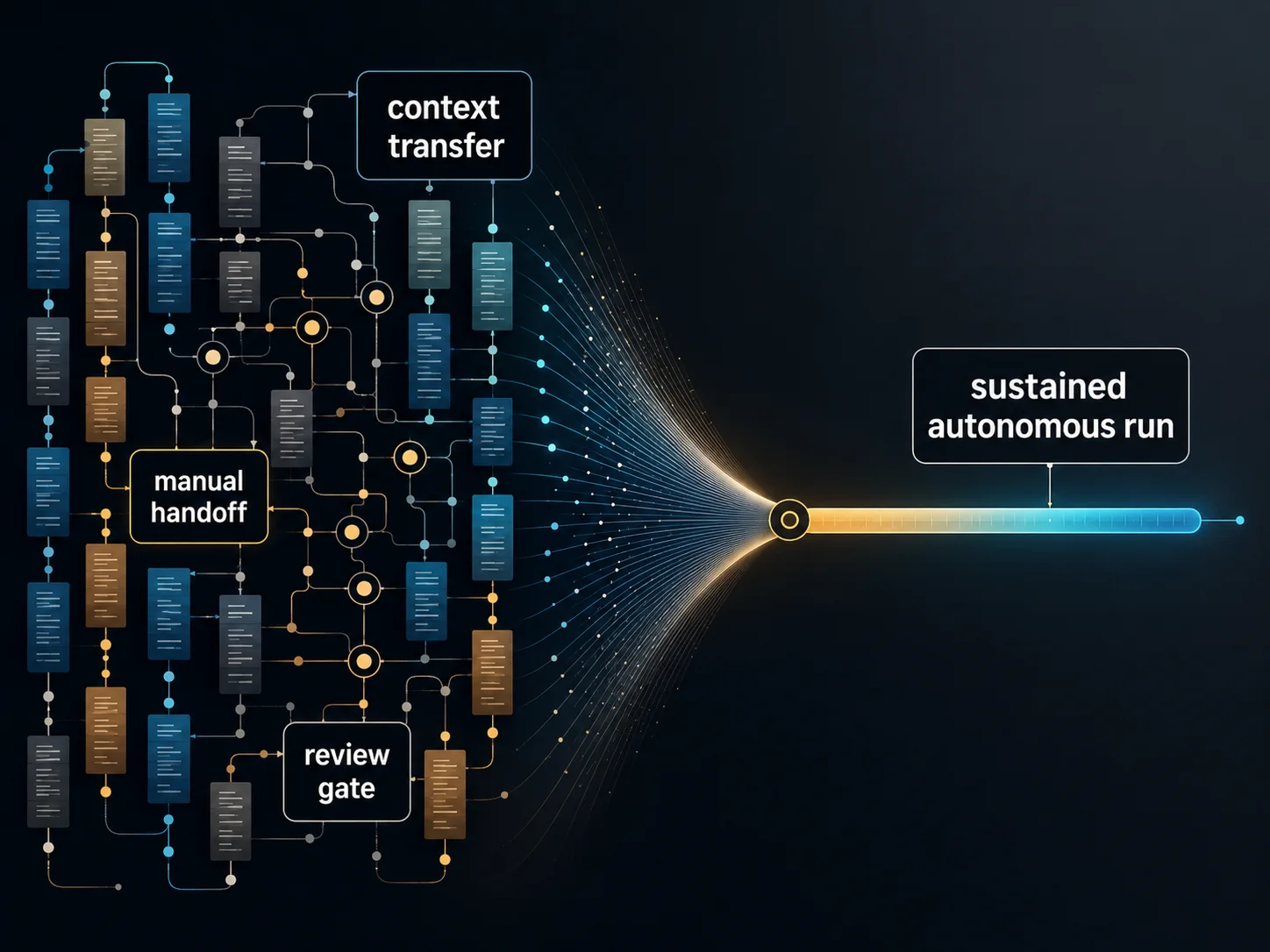
Most AI tools today work in short bursts. You prompt, you get a response, you feed the next step manually. The person operating the tool becomes the memory layer between tasks. That is fine for a single question. It breaks down when the real job is a sequence: research a prospect, check CRM history, draft a follow-up email, update the deal record, brief the next call, produce a content asset around the proof.
A model that can hold focus across millions of tokens in a long-running session changes which workflows can run as one continuous operation instead of a series of manual handoffs.
The commercial work this applies to
Inside a typical B2B SMB, the most expensive coordination problems are sequential chains where context leaks between steps:
- A salesperson researches a prospect, but the notes live in one tool while the follow-up lives in another and the proposal lives in a third.
- A marketing team produces content, but the brief, the draft, the platform adaptation, and the visual direction each require a separate handoff.
- A founder prepares a proposal by pulling CRM data, past deliverables, pricing logic, and proof points from four different places, holding it all in their head.
Each of these is a sustained-context problem. The chain of context across steps is what breaks, and what consumes the most human time.
The people stay in these workflows. What the model takes over is the fragile memory layer between the steps. The salesperson still makes the judgment call on the deal. The system holds the context so the judgment call is informed by everything that happened before it.
Where FTS runs this today
FTS operates its own content production system on Claude Fable 5. A single autonomous run handles drafting, platform adaptation across six channels, voice rule enforcement, evidence checking, visual briefing, and quality gating. That full sequence used to be a multi-person, multi-day workflow. It now runs as one sustained task with human review at the gate.
This is the same capability pattern that applies to CRM enrichment sequences, proposal assembly, sales follow-up chains, and any commercial workflow where one person currently acts as the glue between disconnected tools. It becomes more useful when those workflows are part of one connected commercial engine, rather than a set of isolated AI tasks.
Risks and limits
Autonomous capability at this level requires a real operating layer underneath it. The model holds context, but someone still needs to define what good output looks like, where the human review points sit, and what happens when the system gets something wrong.
A long-running task that produces bad output for hours is worse than a short task that fails fast. The system design matters even more when the model can sustain focus. Quality gates, evidence rules, and human checkpoints are structural requirements.
Pricing also matters at scale. Ten dollars per million input tokens is accessible for production workflows, but a poorly designed autonomous run that processes unnecessary context will still generate unnecessary cost. The system needs to be specific about what it reads, what it produces, and where it stops.
What to evaluate first
If your commercial team has workflow sequences where one person holds context across multiple tools and handoffs, start there. Map the chain. Identify where context leaks between steps. Ask whether a sustained autonomous run with human review at the output could replace the manual coordination in between.
The question is whether your commercial workflows can run as connected sequences instead of manual handoff chains. That is where the operating advantage sits.
All capability and pricing claims reference the Anthropic Claude Fable 5 general availability announcement, June 2026.