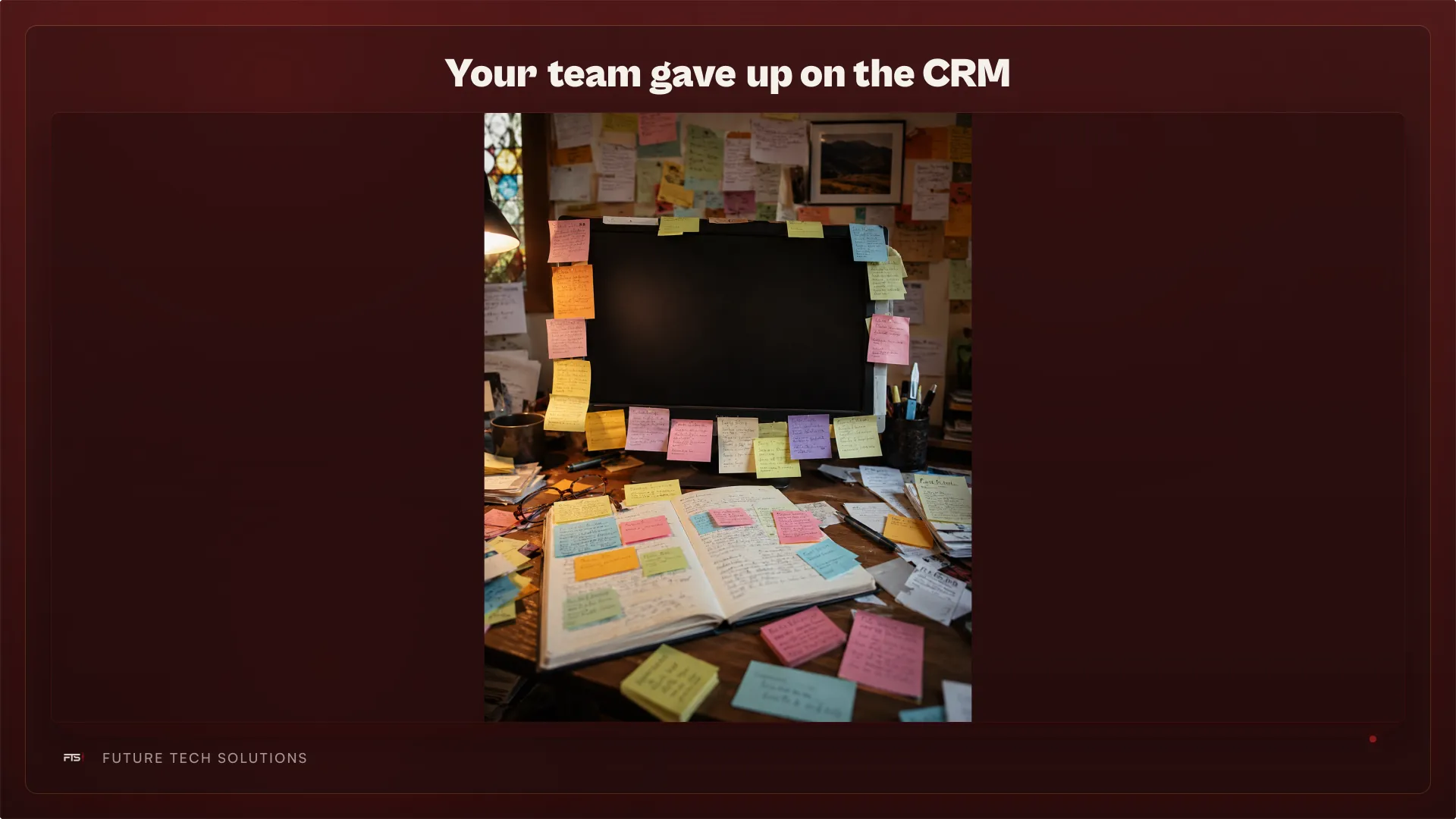
You paid for the CRM and ran the training. For a week or two the team logged their calls and moved their deals along, then it slid. The pipeline drifted back into people's heads, follow-up went back to the inbox, and the CRM became a list with half the fields blank. You cannot forecast from a list like that. Now you are paying every month for a tool your team works around instead of works in.
When we look at a CRM a team has quietly given up on, the reason is almost always the same. A new tool does not fix it. Neither does another round of training.
Why a CRM ends up feeling like storage
A CRM becomes storage when it is set up to collect information and gives nothing back.
Picture it from a rep's seat. Every call ends with a few minutes of logging: what happened, what the deal needs next. None of that comes back to help them sell. The data goes in so a manager can pull a report later. For the person doing the typing, the CRM just makes the afternoon slower and the month no better.
So they do the rational thing. Deals they care about stay in their head, where it is faster, and their actual next steps live on a sticky note or in their inbox. The CRM gets updated just enough to stay out of trouble, usually right before the pipeline meeting. A tool that was supposed to run the business becomes a chore for an audience of one.
That is storage. Information goes in, and it mostly just sits there. You cannot forecast from half-entered records, and you cannot run reliable automation on top of them either.
What a half-used CRM actually costs you
It is easy to treat an unused CRM as a tidiness problem, something to sort out when there is time. That is a mistake.
Half the pipeline sits in people's heads. The number in the CRM is fiction, and you find out about slipped deals only after they have already gone. Follow-up runs on whoever happens to remember: the deals that get chased are the ones a busy rep thinks of on a busy week, and the rest go quiet. Lost deals rarely announce themselves. A deal cools off because nobody followed up at the right moment, and nobody noticed until it was gone.
The owner becomes the backup system. When the CRM cannot be trusted, the real pipeline ends up in the founder's head. They chase the team for updates and personally track which client needs what. The business cannot grow beyond what one person can hold in their head.
Why making them use it never lasts
The first instinct is usually to push harder. You mandate the fields and tie pay to it, then sit on the team until the data is clean. It works for as long as you are watching. In a small business your attention always moves somewhere else, so the discipline decays and the pipeline drifts back into people's heads.
You can police data entry forever, or you can hear what the behaviour is telling you. People do not keep feeding a tool that gives them nothing back. Your team is responding rationally to a CRM that only ever takes from them.
A CRM people use gives them their next move
The CRMs that actually get used run the other way around, giving the person at the keyboard something back every time they open it.
Instead of a blank database, the rep opens the CRM to a short list of what needs doing today. There is a deal gone quiet for ten days, a proposal with no reply since Tuesday, an overnight enquiry waiting for a first call. That CRM becomes the first thing they open in the morning, because it is the fastest way to know what to do.
When that happens, something quietly useful follows. The data stays current on its own, because keeping the record straight is now just part of getting their actual work done rather than a separate chore. The clean pipeline you wanted arrives as a side effect of a tool the team finally finds useful. And that clean pipeline is what everything else runs on, from honest forecasting to the kind of connected commercial engine where sales and marketing finally work off the same records.
Where automation actually fits
A CRM does not surface the next move by magic. Someone has to watch the records and put the right prompt in front of the right person at the right time. In most businesses, that is the part nobody set up, and it is the core of what we build around a team.
Forget chatbots and AI doing your selling. The automation that works here is plain and reliable:
- A deal with no activity for ten days moves itself onto the rep's list.
- A proposal with no reply after three days becomes a follow-up reminder, already addressed to the right person with the file attached.
- New web enquiries create their own record and get assigned to someone, so nothing sits unclaimed in a shared inbox.
- Won deals kick off the onboarding steps without anyone having to remember them.
Take one ordinary example. A proposal goes out on a Tuesday. In a storage CRM, whether it ever gets chased depends entirely on whether the rep remembers, and on a full week they often do not. Set up the other way, the CRM is watching that proposal, and when Friday arrives with no reply the follow-up is already on the rep's list, ready to go. The rep spends thirty seconds deciding how to chase it instead of never thinking about it again. Multiply that across every proposal, every quiet deal, and every overdue check-in, and you can see where the lost revenue in a small business actually hides.
The rep still makes every judgment call: how to handle the deal, what to say, whether the timing is right. What the automation removes is the remembering. It is the same line long-running autonomous AI is drawing across commercial work: judgment stays with your team, coordination moves to the system. Following up at the right moment depends on one person holding twenty open loops in their head and never dropping one. The team you already have does their real job while the coordination runs in the background.
Automation on top of bad data just makes faster noise
There is a wrong order to do this in, and getting it backwards wastes a lot of money.
If you bolt automation onto a CRM full of stale, half-entered records, you do not fix the problem. You accelerate it. Wrong reminders go to the wrong people, and deals get handed off with context missing. The team trusts the system even less than before, having spent budget making the mess move faster rather than clearing it up.
Get one workflow giving something back first. Prove the team will use the CRM when it is actually useful to them, then automate the parts that are reliable, one at a time. The order matters more than the tooling.
What to fix first
You do not need a six-month project or a new platform to test this. Start small and concrete:
- Pick one workflow that genuinely hurts right now, usually follow-up after calls or chasing sent proposals.
- Cut the fields you ask reps to fill down to the few that actually drive a decision. Every extra field is a tax with no return.
- Set the CRM to show each person a short daily list of what needs doing, instead of a blank screen they have to go searching in.
- Automate the one reminder that currently depends on somebody remembering.
- Then stop telling them to use it, and watch whether they reach for it on their own.
That last point is the only real test. If the team opens the CRM without being told, because it is the quickest way to know what to do next, the setup is right. The rest follows. When they still avoid it, it is still storage, and no amount of training will change that.
So start with the follow-up that slips most often in your business. Set the CRM to put it in front of the right person first thing tomorrow, already filled in and ready to act on. Then watch what they do with it.